Can computers understand morality?
Can they respect our privacy?
How can we make AI safe and fair?
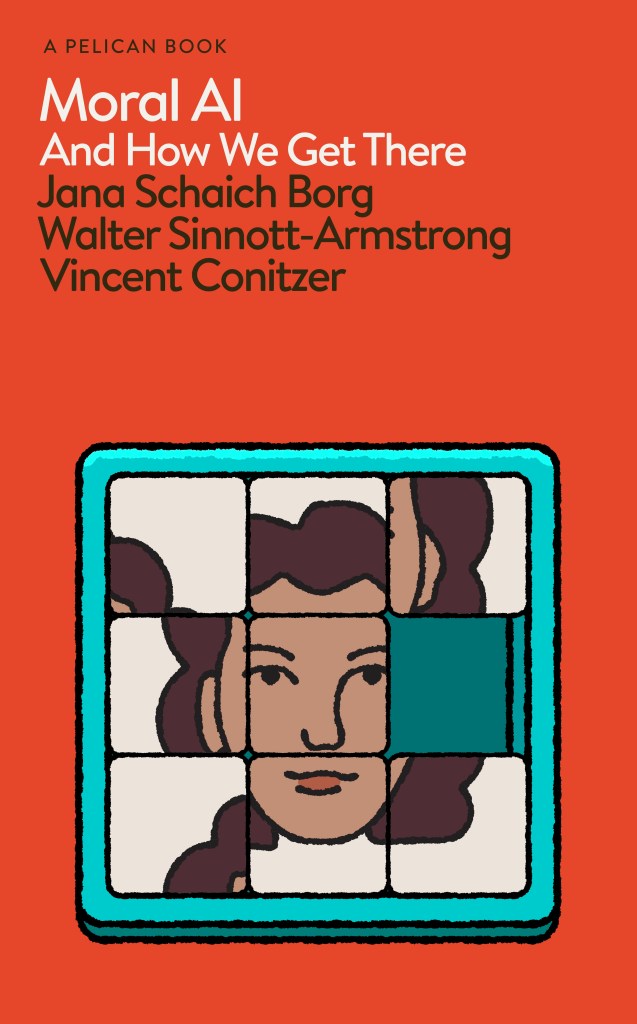
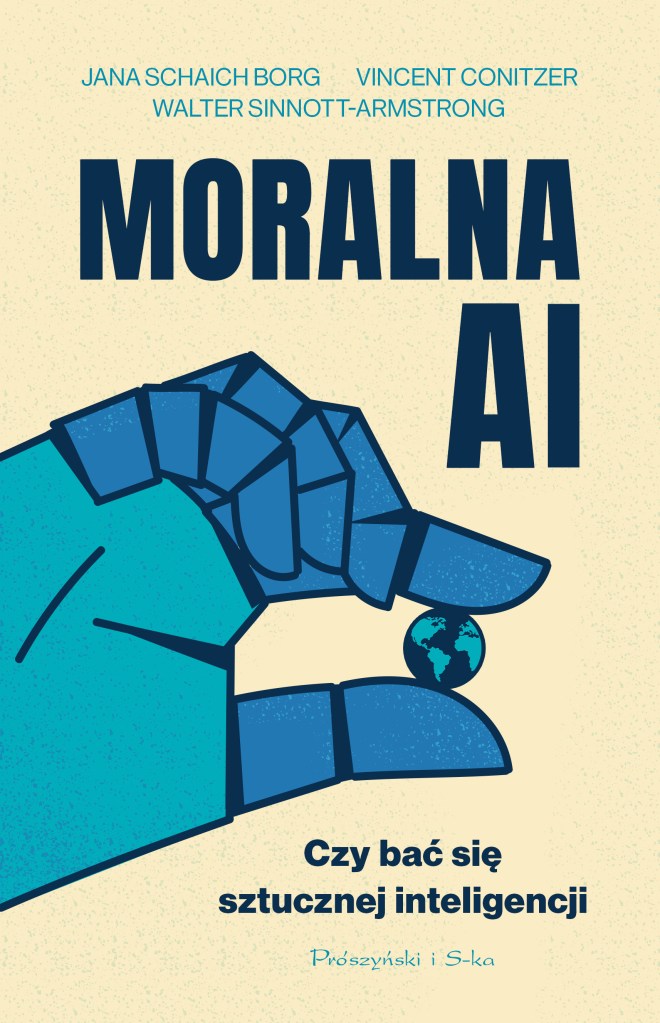
Moral AI and How We Get There (2024) by Jana Schaich Borg, Walter Sinnott-Armstrong, and Vincent Conitzer
The artificial intelligence revolution has begun. Today, there are self-driving cars on our streets, autonomous weapons in our armies, robot surgeons in our hospitals – and AI’s presence in our lives will only increase. Some see this as the dawn of a new era in innovation and ease; others are alarmed by its destructive potential. But one thing is clear: this is a technology like no other, one that raises profound questions about the very definitions of human intelligence and morality.
In Moral AI, world-renowned researchers in moral psychology, philosophy, and artificial intelligence – Jana Schaich Borg, Walter Sinnott-Armstrong and Vincent Conitzer – tackle these thorny issues head-on. Writing lucidly and calmly, they lay out the recent advances in this still nascent field, peeling away the exaggeration and misleading arguments. Instead, they offer clear examinations of the moral concerns at the heart of AI programs, from racial equity to personal privacy, fake news to autonomous weaponry. Ultimately, they argue that artificial intelligence can be built and used safely and ethically, but that its potential cannot be achieved without careful reflection on the values we wish to imbue it with. This is an essential primer for any thinking person.
Purchase Moral AI and How We Get There through Amazon, Penguin, Barnes and Noble, or Audible.
1 of 5 “best science picks” in Nature
Table of Contents
Preface
Introduction: What’s the Problem?
What is AI?
Can AI be safe?
Can AI respect privacy?
Can AI be fair?
Can AI (or its creators or users) be responsible?
Can AI incorporate human morality?
What can we do?
Conclusion: It’s Up to Us
References
Index
What People Are Saying
“A stimulating analysis of moral dilemmas in AI with snippets of both good and bad AI-related news — from the worlds of art, environment, investment, law, media, medicine, the military, politics and more.”
—Nature
“A philosopher, data scientist and computer scientist tackle the key ethical challenges of AI safety, privacy, fairness, responsibility and how to inject human morality into AI. Practical and peppered with lively examples. This is a must-have as AI fundamentally changes all of our lives. Balanced, thoughtful and engaging.”
—Julian Savulescu
“Can we build and use AI ethically? I believe this book gives the best answer to this question: yes, but it is up to us, so we all have to make an effort. If you want to understand the impact of AI on our lives, and how to make it a positive one, you need to read it.”
—Francesca Rossi
“Taking on the challenge of AI calls for perspectives grounded in multiple areas of expertise, and that is what Moral AI provides. . . A judicious and deeply-informed guide.”
—Peter Railton
“Moral AI is a gracefully written and balanced book which should be required reading for all humans and generations of ChatGPTs. Written by an exceptional interdisciplinary team, it eschews hyperbole and brings what the Greeks would call phronesis – or practical wisdom – to the modern challenge of artificial intelligence.”
—Joseph J. Fins
“The authors blend their expertise from diverse fields to provide fresh insights and feasible suggestions for balancing AI advancement with ethical considerations. The book is a timely and significant contribution, particularly relevant now. It serves as a guiding light, both for those who are getting started on the journey, and for those who are looking for a fresh perspective.”
—Abhishek Gupta
“Thought-provoking and slightly terrifying.”
—Vanessa Fuller
“A must-read for anyone grappling with the ethical implications of AI. This book deftly tackles the critical questions surrounding AI’s integration into society, from privacy concerns to the moral algorithms guiding autonomous vehicles and military drones.”
—Maddy
“An excellent book that captures who and how AI is being built, the biases that are hardwired in, the opportunities and dangers of its current path, and critically what must be done now to ensure that it reflects our values, our ethics, our law and society. Written by three brilliant researchers, the language is accessible and the actions succinct.”
—Tommy Sowers
Thank you for your review
Authors of Moral AI and How We Get There

Jana Schaich Borg
Dr. Jana Schaich Borg is neuroscientist who has been adopted by data scientists and computer scientists. As an expert in social cognition, empathy, and Moral AI, she uses neuroscience, computational modeling, and emerging technologies to develop strategies to improve social interactions and to understand how and why humans make our moral decisions, and how AI can behave in ways that are aligned with human moral values. With colleagues in computer science and philosophy, she is also working on ways humans and AI can work together to improve human moral learning, reasoning, and behavior overall. Another main thread of her research is dedicated to how “social synchrony”—or coordination of people’s movements, emotions, physiology, and brains over time—impacts social assessments, communication, and behavior, as well as health.

Walter Sinnott-Armstrong
Walter Sinnott-Armstrong is the Chauncey Stillman Professor of Practical Ethics in the Department of Philosophy and the Kenan Institute for Ethics at Duke University. He holds secondary appointments in Duke’s Law School, Department of Psychology and Neuroscience, and Institute for Brain Science. He serves as Resource Faculty in the Philosophy Department of UNC at Chapel Hill, Partner Investigator at the Oxford Uehiro Centre for Neuroethics, and Research Scientist with The Mind Research Network in New Mexico. His current work focuses political polarization, moral artificial intelligence, free will and moral responsibility, narratives and reasons, framing effects, moral foundations, and various other topics in moral psychology and brain science.

Vincent Conitzer
Vincent Conitzer is Professor of Computer Science (with affiliate/courtesy appointments in Machine Learning, Philosophy, and the Tepper School of Business) at Carnegie Mellon University, where he directs the Foundations of Cooperative AI Lab (FOCAL). He is also Head of Technical AI Engagement at the Institute for Ethics in AI, and Professor of Computer Science and Philosophy, at the University of Oxford. Previous to joining CMU, Conitzer was the Kimberly J. Jenkins Distinguished University Professor of New Technologies and Professor of Computer Science, Professor of Economics, and Professor of Philosophy at Duke University. He received Ph.D. (2006) and M.S. (2003) degrees in Computer Science from Carnegie Mellon University, and an A.B. (2001) degree in Applied Mathematics from Harvard University.
Buy the book
Moral AI and How We Get There
by Jana Schaich Borg, Walter Sinnott-Armstrong, and Vincent Conitzer
Hardcover | Paperback | eBook | Audiobook
 Jana Schaich Borg